Say No Ragging
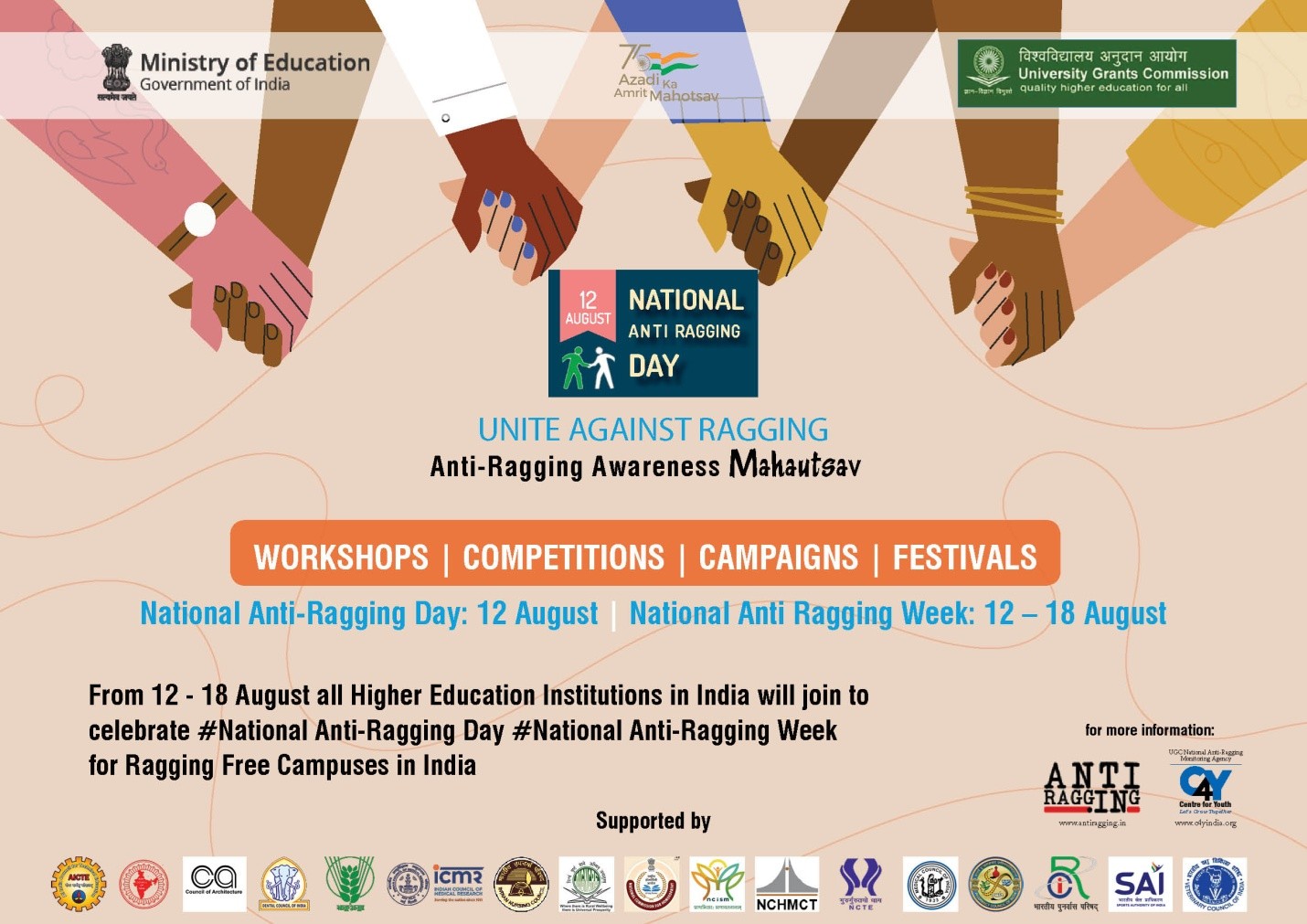
Ragging is a disturbing reality in the higher education system of our country. Despite the fact that over the years ragging has claimed hundreds of innocent lives and has ruined the careers of thousands of bright students, the practice is still perceived by many as a way of ‘familiarization’ and an ‘initiation into the real world’ for young college-going students.
Meaning and definition of ragging
The Supreme Court defined ragging in the Vishwa Jagriti matter (1999) as, "Any disorderly conduct whether by words spoken or written or by an act which has the effect of teasing, treating or handling with rudeness any other student, indulging in rowdy or undisciplined activities which causes or is likely to cause annoyance, hardship or psychological harm or to raise fear or apprehension thereof in a fresher or a junior student or asking the students to do any act or perform something which such student will not in the ordinary course and which has the effect of causing or generating a sense of shame or embarrassment so as to adversely affect the physique or psyche of a fresher or a junior student." ( Raghavan Committee Report, 2007, para. 3.19).
Other organisations/bodies working in this field have also attempted to define ragging, the variety of definitions being reflective of differences in perspective and interpretation. In 2007, the Committee of Consultants to Raghavan Committee considered ragging "neither a means of familiarization nor an introduction with freshers, but a form of psychopathic behaviour and a reflection of deviant personalities. Further, ragging reproduces the entrenched power configurations prevalent in civil society" (Raghavan Committee Report, 2007).
According to the UGC Regulation on Curbing the Menace of Ragging in Higher Institutions, 2009, ragging constitutes one or more of any of the following acts:
Any conduct by any student or students whether by words spoken or written or by an act which has the effect of teasing, treating or handling with rudeness a fresher or any other student.
- Asking any student to do any act which such student will not in the ordinary course do and which has the effect of causing or generating a sense of shame, torment or embarrassment so as to adversely affect the physique or psyche of such fresher or any other student.
- Any act by a senior student that prevents, disrupts or disturbs the regular academic activity of any other student or a fresher.
- Exploiting the services of a fresher or any other student for completing the academic tasks assigned to an individual or a group of students.
- Any act of financial extortion or forceful expenditure burden put on a fresher or any other student by students
- Any act of physical abuse including all variants of it: sexual abuse, homosexual assaults, stripping, forcing obscene and lewd acts, gestures, causing bodily harm or any other danger to health or person;
- Any act or abuse by spoken words, emails, posts, or public insults would also include deriving perverted pleasure, and vicarious or sadistic thrill from actively or passively participating in the discomfiture to fresher or any other student.
- Any act of physical or mental abuse (including bullying and exclusion) targeted at another student (fresher or otherwise) on the ground of colour, race, religion, caste, ethnicity, gender (including transgender), sexual orientation, appearance, nationality, regional origins, linguistic identity, place of birth, place of residence or economic background.
- UGC Regulation on Curbing the Menace of Ragging in Higher Educational Institutions, 2009
- In order to address the issue of increase in ragging cases in campuses, the University Grants Commission (UGC) has brought out the UGC Regulations on Curbing the Menace of Ragging in Higher Educational Institutions, 2009. These regulations are to be followed mandatorily by all Higher Educational Institutions (HEIs).
Measures for the prohibition of ragging
UGC has established an Anti-Ragging toll-free “helpline” 1800-180-5522 in 12 languages for helping victims of ragging.
The UGC has developed an Anti-Ragging Website - https://www.antiragging.in/. The Portal contains the record of registered complaints received and the status of the action taken thereon.
Videos on Anti ragging are available on the UGC website.
Punishments accorded
According to the UGC Regulation on Curbing the Menace of Ragging in Higher Educational Institutions, 2009, depending on the nature and gravity of the guilt established by the Anti-Ragging Squad, those found guilty may be awarded one or more of the following punishments, namely;
- Suspension from attending classes and academic privileges.
- Withholding/ withdrawing scholarship/ fellowship and other benefits.
- Debarring from appearing in any test/ examination or another evaluation process.
- Withholding results.
- Debarring from representing the institution in any regional, national or international meet, tournament, youth festival, etc.
- Suspension/ expulsion from the hostel.
- Cancellation of admission.
- Rustication from the institution for periods ranging from one to four semesters.
- Expulsion from the institution and consequent debarring from admission to any other institution for a specified period.
College Anti Ragging Committee:
|
Prof Kamble Pralhad Namdev
|
In Charge
|
|
Dr.Tayade Sanjay Bhaskar
|
Member
|
|
Dr. Ghadi Gurunath Eknat
|
Member
|